PROJECT 03
McDonald's Happy Meal Toy
Background
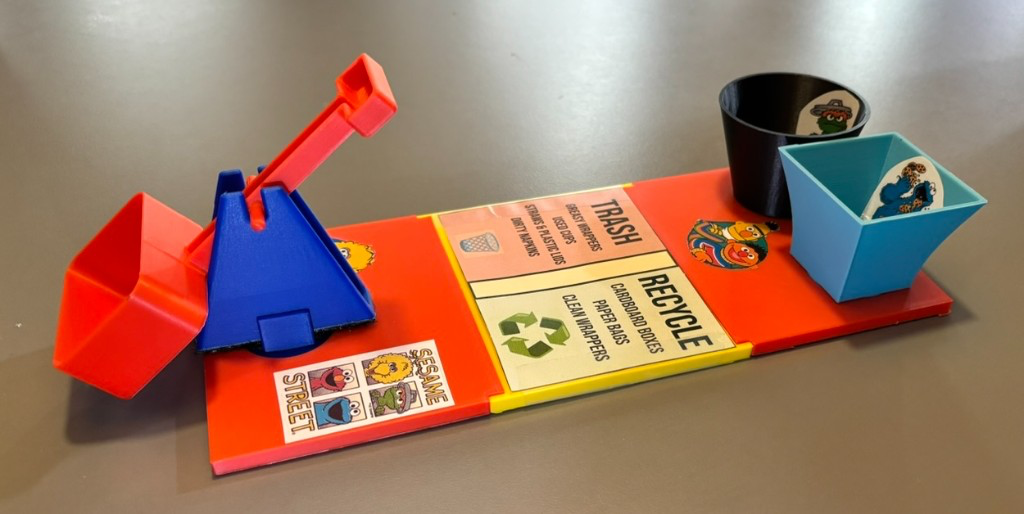
As part of a four-person team in my EGR 121 class, I designed and developed Grouch’s Garbage Game, an interactive McDonald’s Happy Meal toy that turns waste sorting into a game. The concept uses a rotating catapult to launch items from a Happy Meal—such as wrappers and packaging—into separate trash and recycling bins, combining play with environmental education.
Our goal for this assignment was to develop a toy that was safe for children, intuitive to use, environmentally conscious, and feasible for high-volume manufacturing. Early concepts were evaluated against four primary design constraints: safety, manufacturability, usability, and environmental impact. Concepts involving small game pieces and complex sealed assemblies were eliminated because of choking-hazard, manufacturing, or recyclability concerns.
We ultimately developed a modular waste-sorting game consisting of a catapult mechanism, rotating aiming base, interlocking platforms, and separate trash and recycling bins. The launcher rotates between the two targets, allowing the player to aim before pressing the lever to launch an item.
Engineering & Design
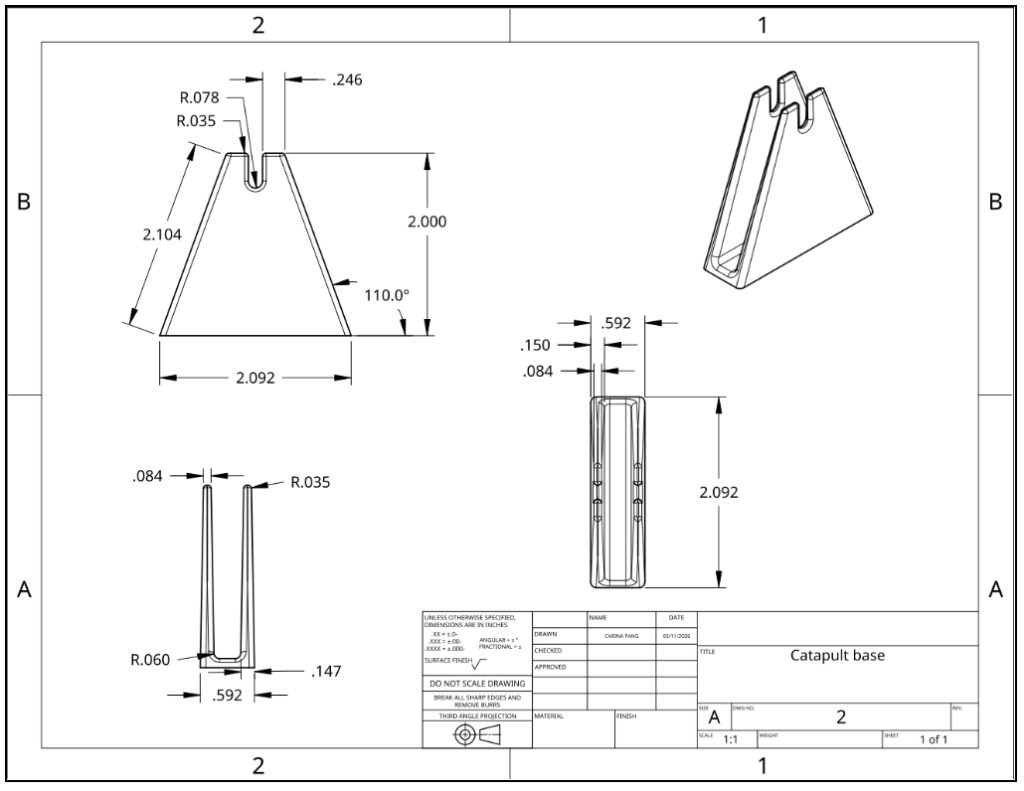
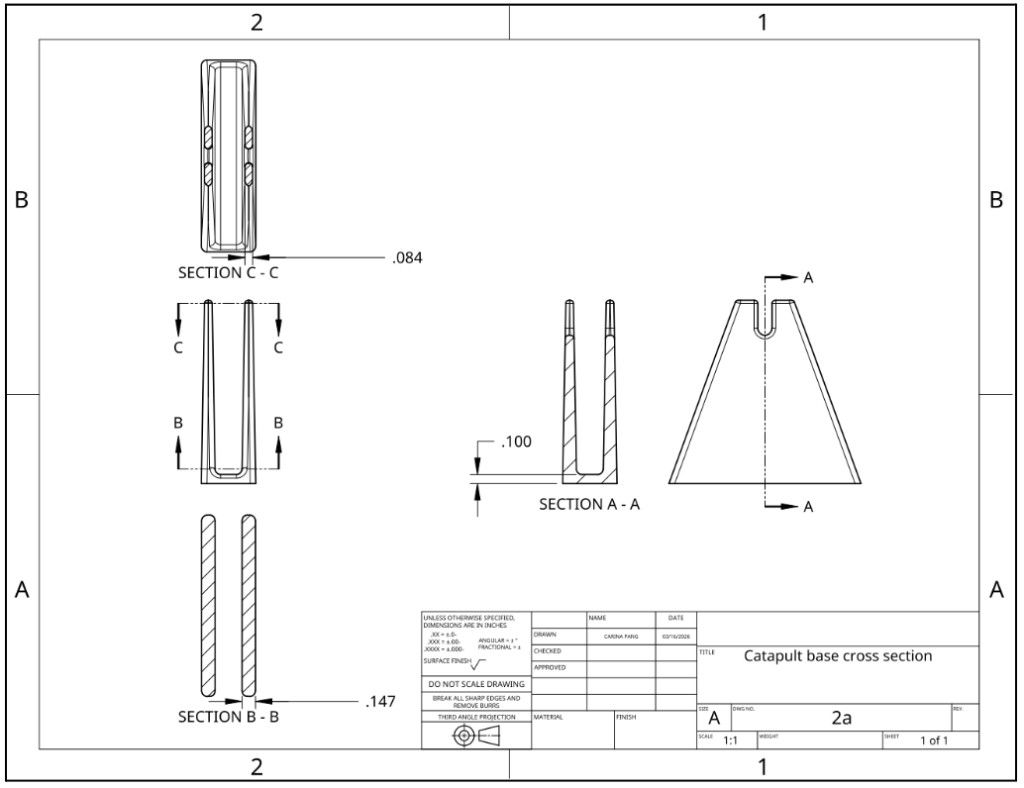
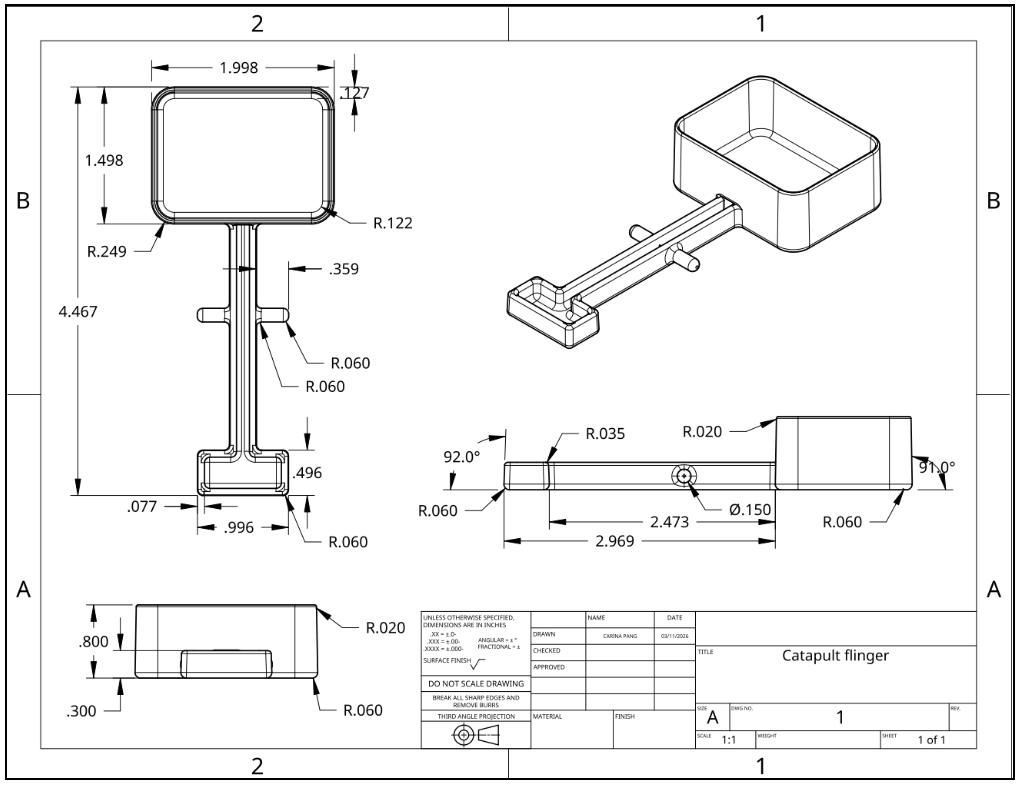
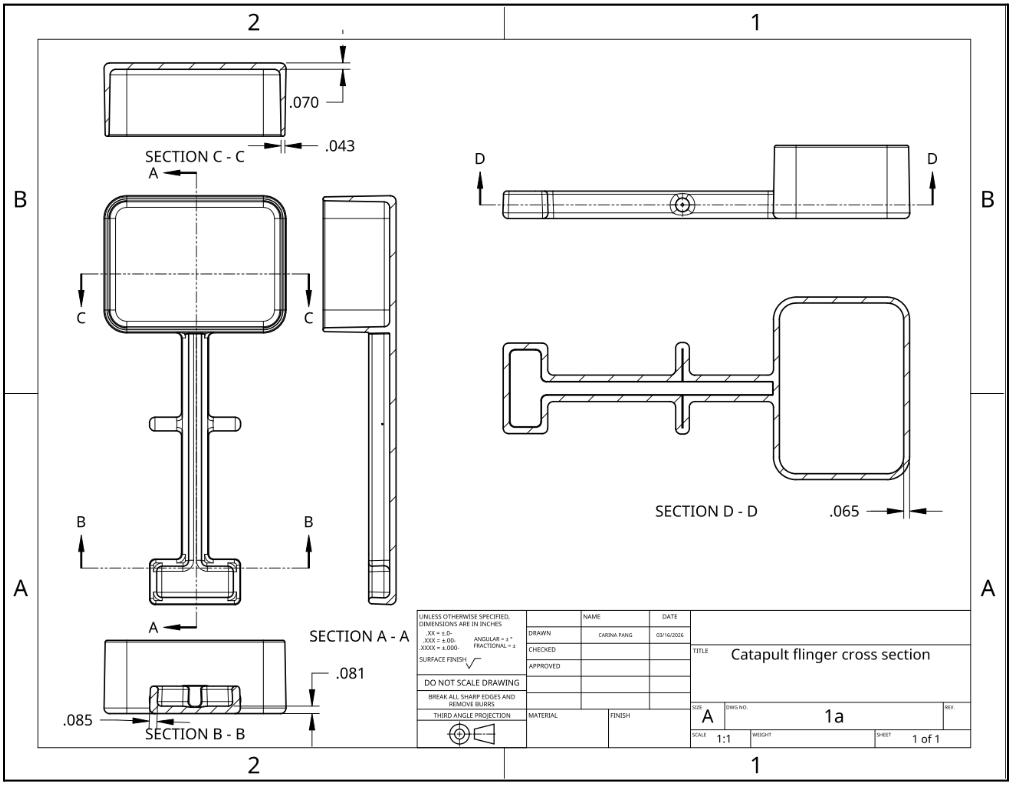
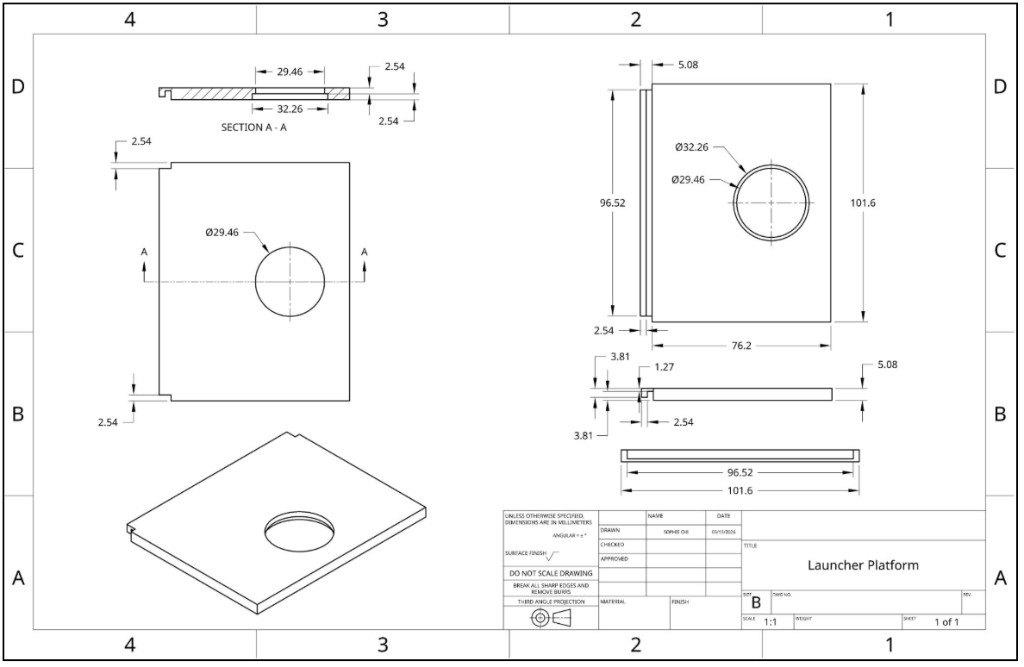
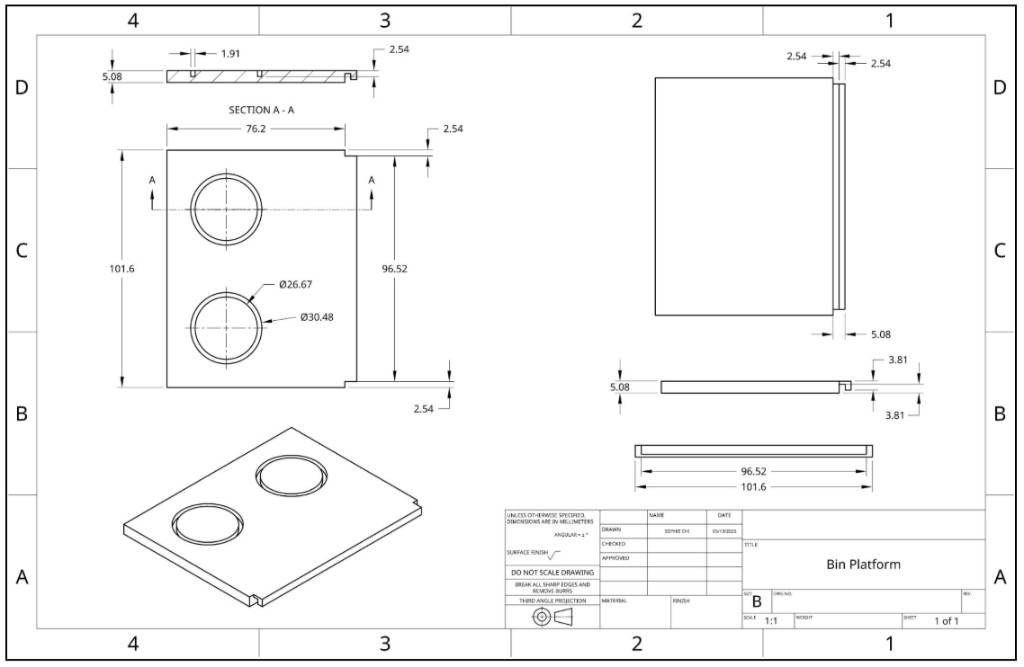
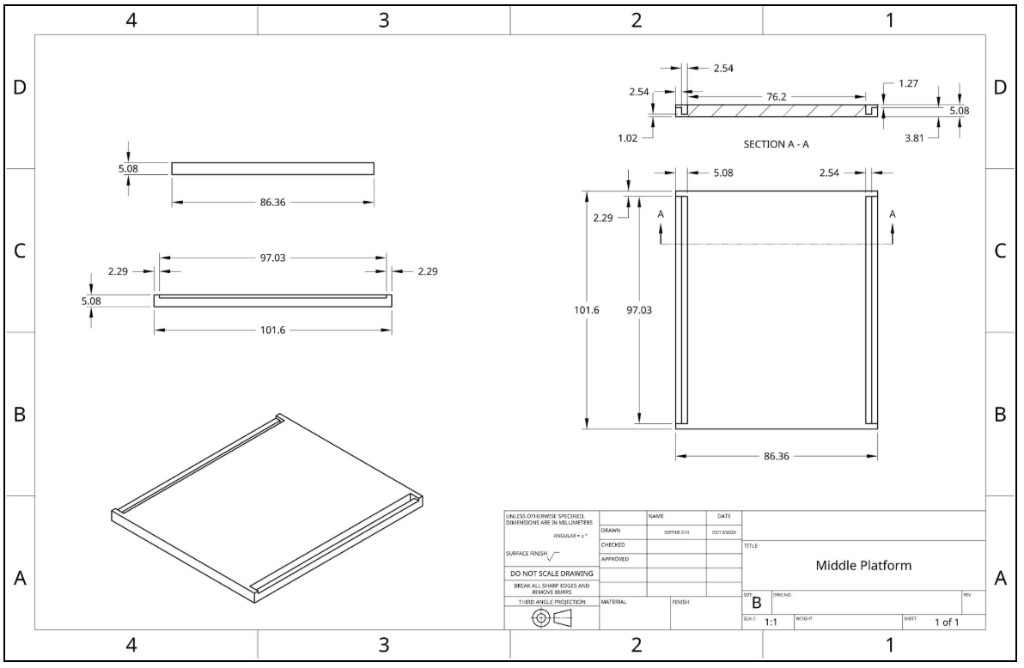
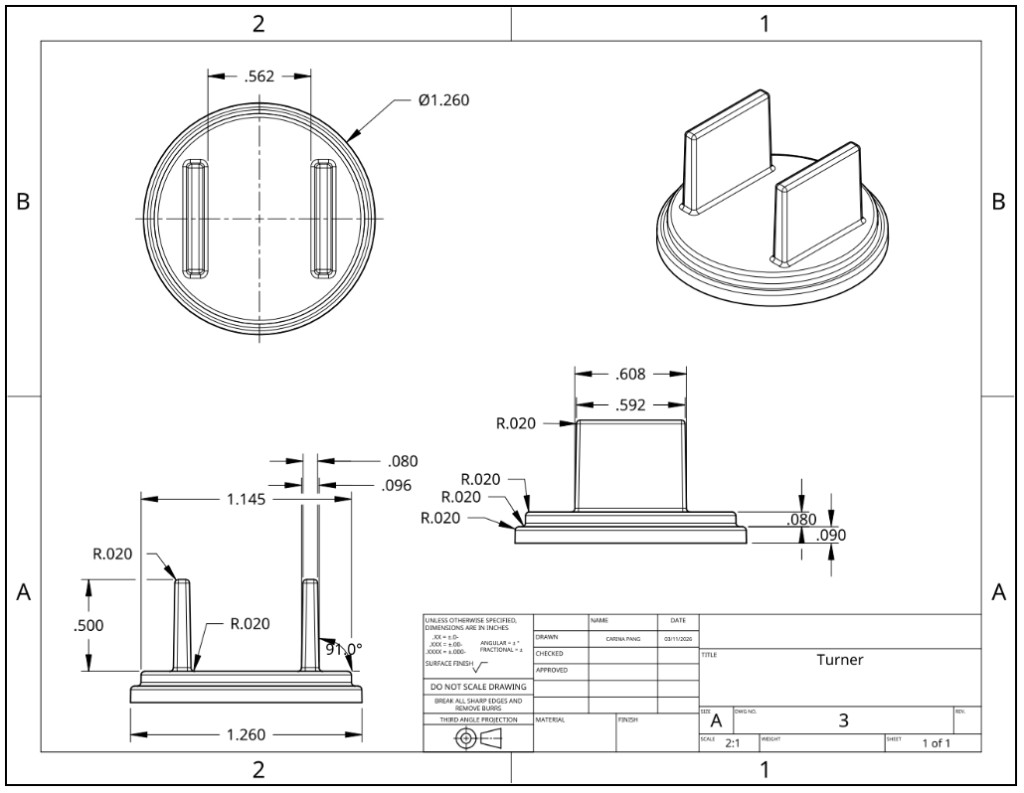
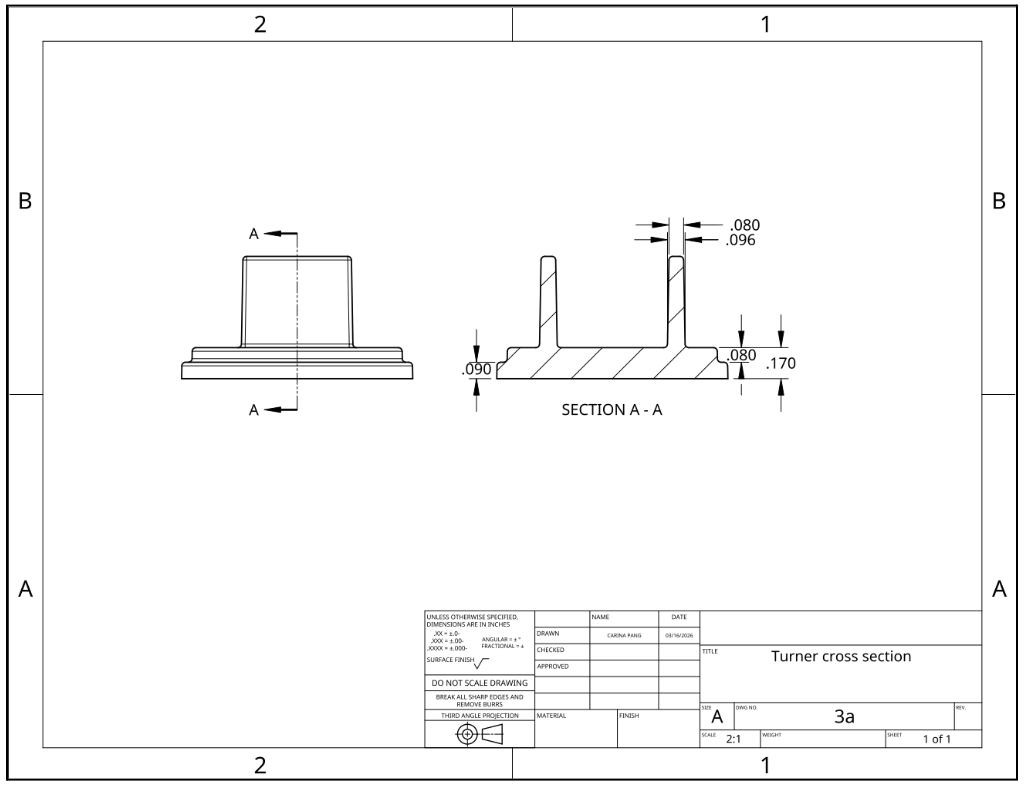
The toy was developed in CAD with an emphasis on critical-to-function dimensions, tolerance stack-ups, reliable assembly, and injection-molding design principles. The launcher uses a pivoting arm seated in a triangular support, while a circular turner beneath the assembly allows the entire launcher to rotate toward either bin. The three-piece platform uses precision interlocking features so the product can be assembled into a flat playing surface.
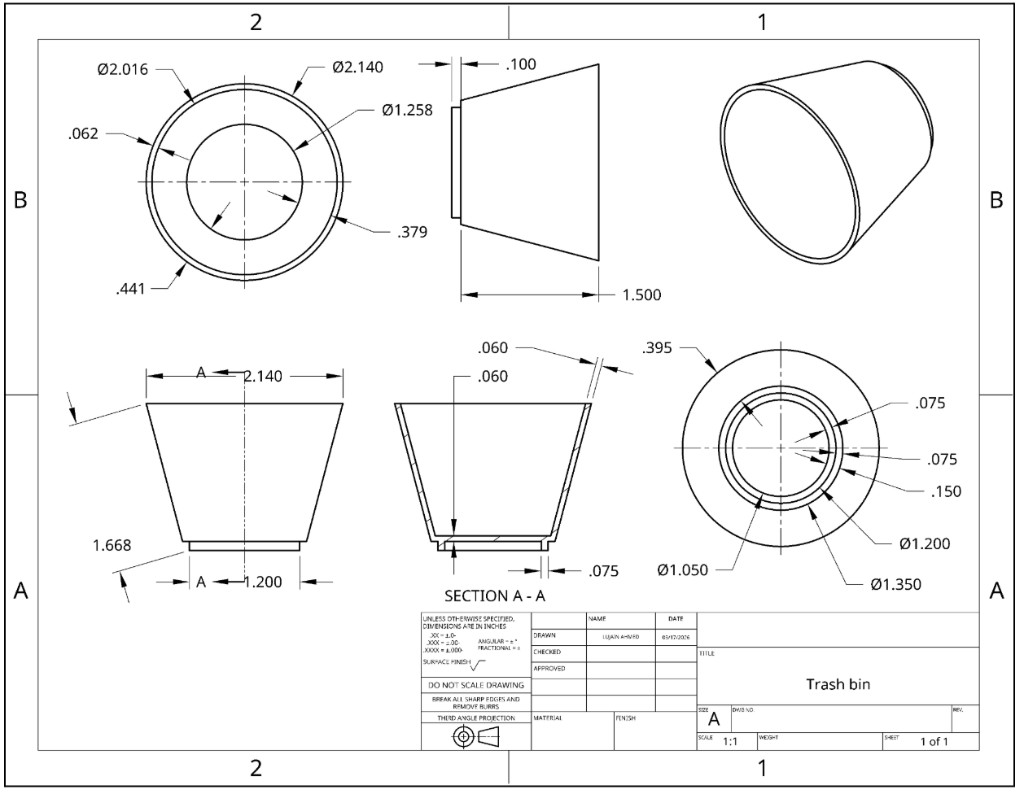
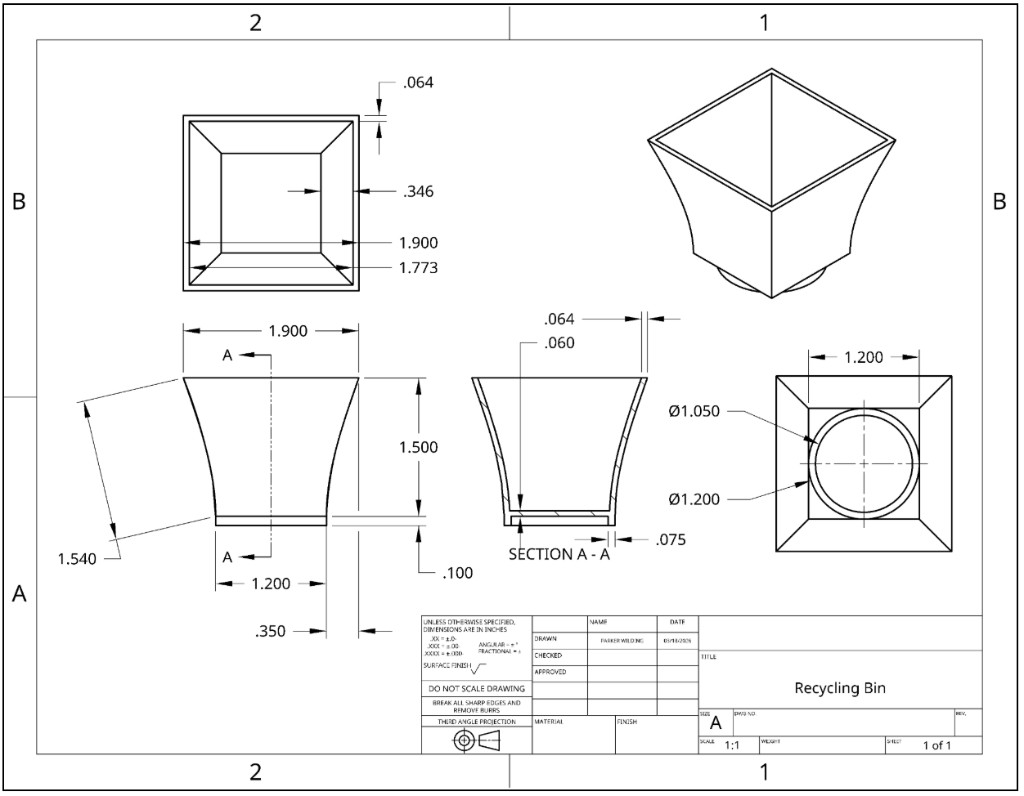
We worked with design tolerances of approximately ±0.003–0.004 in (≈±0.1 mm) for prototyped interfaces and incorporated controlled clearances into moving components. For example, the rotating platform opening was designed 0.01 in larger than the turner to provide smooth rotation, while the bin-platform interfaces were dimensioned to prevent the targets from wobbling or rotating during play.
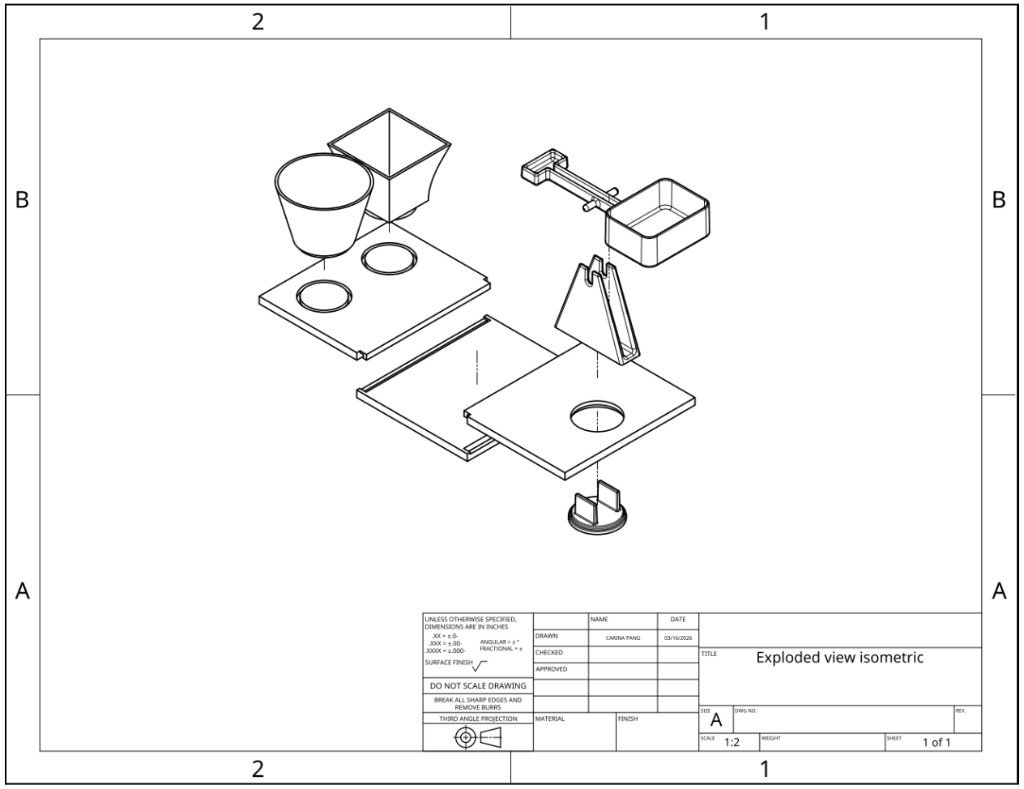
The exploded assembly drawing demonstrates how the bins, three platform sections, rotating launcher base, support, and catapult combine into the complete product.
Design for Manufacturing
Because a Happy Meal toy must be produced at extremely high volumes and low cost, the design was developed specifically for injection molding. Components use straight-pull geometry without undercuts, 1–2° draft angles, wall thicknesses between 0.030 and 0.180 in, and fillets sized at approximately 25–50% of nominal wall thickness. These choices simplify tooling while reducing risks such as warping, sink marks, stress concentrations, and inconsistent cooling.
The final design uses ABS for its impact resistance, dimensional stability, and suitability for mass production. Manufacturing analysis estimated a $0.54 unit production cost, including approximately $0.268 in material and $0.27 in molding costs, with multi-cavity tooling considered for production volumes in the tens of millions of components per year.
02/27/2024 RGT
| # | Part Name | Projected Areain² | Cavities per Tool# | Inj. Press.tons | Press Sizetons | Attended? | Press Cost$/hr | Cycle Timesec | Yield Rate% | Parts / Hour# | Molding Cost$ | Material | Specific Gravity | Part Volumecc | Part Volin³ | Part Weightlbs | Raw Mat. Cost$/lb | Part Mat. Cost$ | Total Part Cost$ | Tools# | Run time/dayhrs | Working days/wk | Parts / year# | Total Cost$ |
|---|---|---|---|---|---|---|---|---|---|---|---|---|---|---|---|---|---|---|---|---|---|---|---|---|
| 1 | Bin Platform | 12.8 | 12 | 6 | 919 | No | 90 | 30 | 99.999 | 1440 | $0.063 | ABS | 1.06 | 39.71 | 2.42 | 0.093 | $0.68 | $0.063 | $0.13 | 1 | 23.5 | 7 | 12,317,637 | $1,547,049 |
| 2 | Launcher Platform | 11.7 | 12 | 6 | 843 | No | 90 | 30 | 99.999 | 1440 | $0.063 | ABS | 1.06 | 36.77 | 2.24 | 0.086 | $0.68 | $0.058 | $0.12 | 1 | 23.5 | 7 | 12,317,637 | $1,489,634 |
| 3 | Middle Platform | 13.6 | 12 | 6 | 979 | No | 90 | 30 | 99.999 | 1440 | $0.063 | ABS | 1.06 | 42.08 | 2.57 | 0.098 | $0.68 | $0.067 | $0.13 | 1 | 23.5 | 7 | 12,317,637 | $1,593,558 |
| 4 | Launcher | 3.7 | 24 | 6 | 533 | No | 59 | 30 | 99.999 | 2880 | $0.020 | ABS | 1.06 | 14.72 | 0.90 | 0.034 | $0.68 | $0.023 | $0.04 | 1 | 23.5 | 7 | 24,635,274 | $1,080,762 |
| 5 | Launcher Base | 0.9 | 24 | 6 | 130 | No | 33 | 30 | 99.999 | 2880 | $0.011 | ABS | 1.06 | 11.60 | 0.71 | 0.027 | $0.68 | $0.018 | $0.03 | 1 | 23.5 | 7 | 24,635,274 | $736,471 |
| 6 | Turner | 1.2 | 24 | 6 | 180 | No | 33 | 30 | 99.999 | 2880 | $0.011 | ABS | 1.06 | 4.03 | 0.25 | 0.009 | $0.68 | $0.006 | $0.02 | 1 | 23.5 | 7 | 24,635,274 | $440,093 |
| 7 | Trash Bin | 3.6 | 24 | 6 | 517 | No | 59 | 30 | 99.999 | 2880 | $0.020 | ABS | 1.06 | 9.68 | 0.59 | 0.023 | $0.68 | $0.015 | $0.04 | 1 | 23.5 | 7 | 24,635,274 | $883,818 |
| 8 | Recycling Bin | 3.6 | 24 | 6 | 520 | No | 59 | 30 | 99.999 | 2880 | $0.020 | ABS | 1.06 | 10.13 | 0.62 | 0.024 | $0.68 | $0.016 | $0.04 | 1 | 23.5 | 7 | 24,635,274 | $901,139 |
- Total Part Cost
- $0.54
- Total Cost
- $8,672,523
Drawings
Final Design
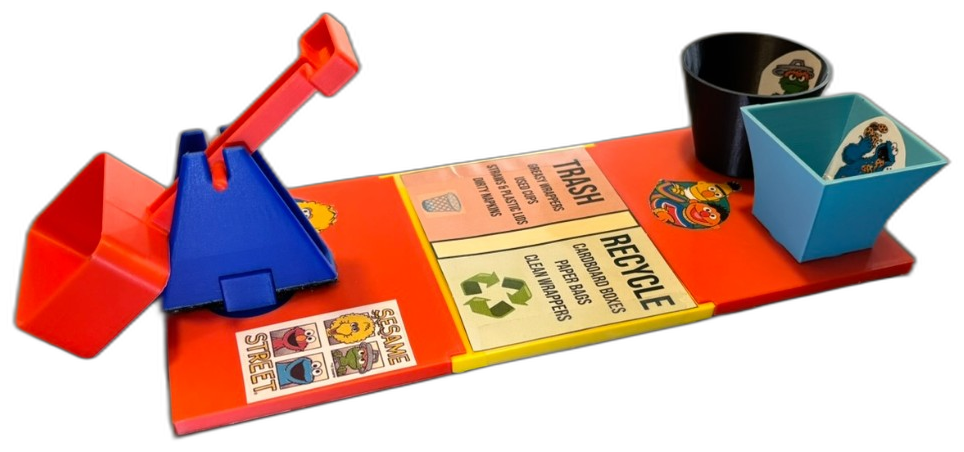
Grouch’s Garbage Game meets all functional, safety, and manufacturability requirements while delivering a meaningful and engaging user experience. The design uses large, safe components that comply with choking hazard standards, and its fully injection-moldable geometry enables efficient, high-volume production at a competitive unit cost of $0.54.
In addition to its technical feasibility, the toy provides strong educational value and supports sustainability goals. By incorporating real Happy Meal waste into gameplay, the design reinforces proper disposal habits and environmental awareness in an interactive and memorable way. This combination of play and learning increases both child engagement and parent appeal.
From a manufacturing perspective, the use of standardized materials and simple tooling supports scalable production at very high volumes, making the design compatible with McDonald’s large-scale distribution model.
Overall, Grouch’s Garbage Game is an innovative, cost-effective, and manufacturable solution that also promotes environmental responsibility, making it a strong candidate for future Happy Meal implementation.
The project gave me hands-on experience translating a product concept into a manufacturable mechanical design, including iterative CAD development, 3D-printed prototyping, tolerance analysis, component interfaces, material selection, injection-molding DFM, and cost estimation. The final concept satisfied the assignment’s functional, safety, and manufacturability requirements while reaching an estimated production cost appropriate for high-volume distribution.